The Curriculum of a Better Life
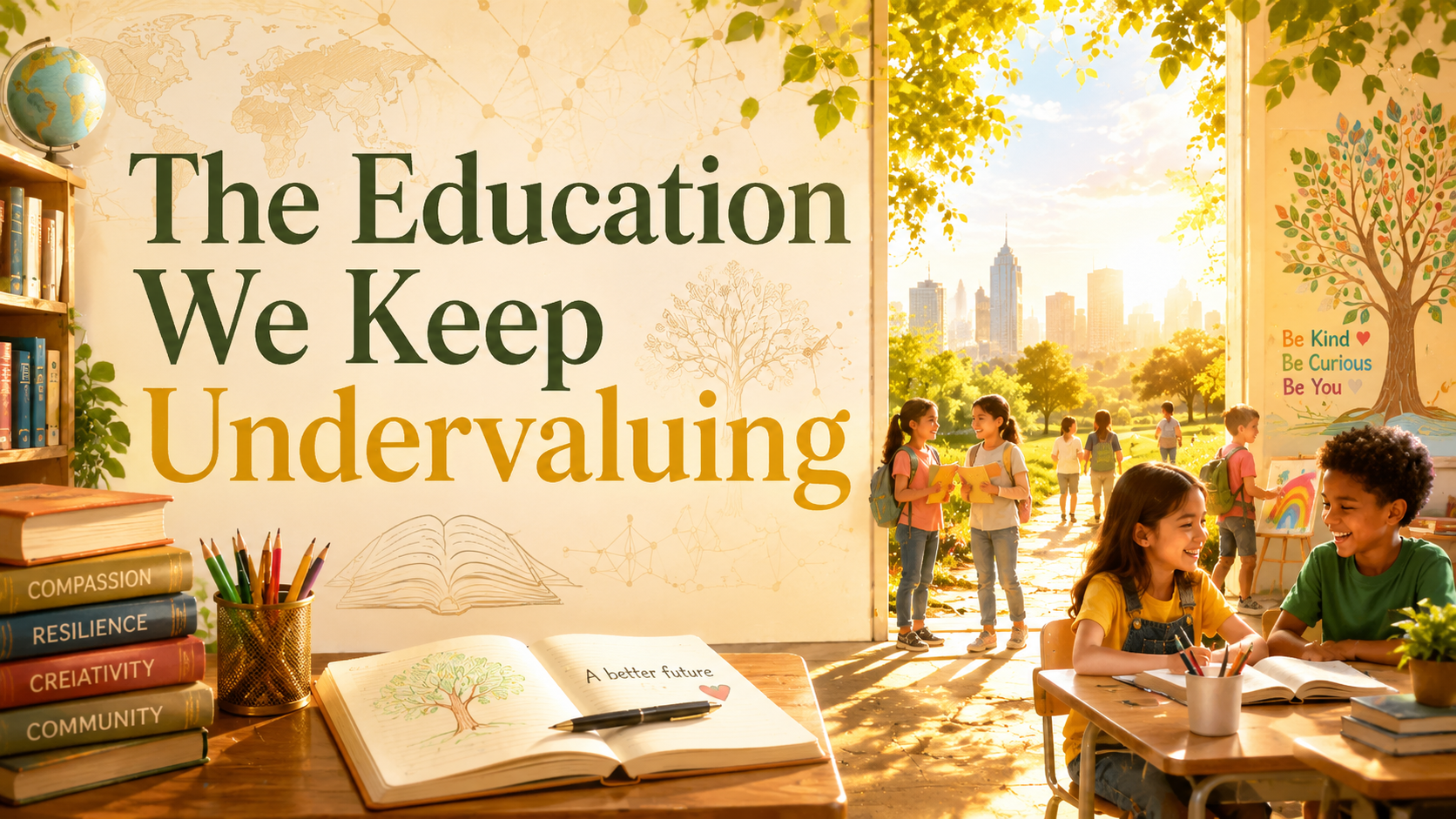
We keep saying education is important. But if we truly believed that, our schools would look very different.
The truth is that we have undervalued education for a very long time. Not in words, but in design. Not in emotion, but in structure. We have treated education as a system of marks, exams, admissions, degrees, and safe careers.
That model worked for a different world.
It will not work for the world our children are entering now.
AI is changing how people learn, work, think, create, write, code, analyse, and compete. In such a world, education cannot remain a memory test. It cannot remain a race of syllabus completion. It cannot remain a system where children are told to study for the next exam, but not trained for the next life.
If we do not reform education at its foundation, we will keep undervaluing it.
And worse, we will produce children who know how to answer questions, but not how to ask better ones.
Education Must Become AI-Resilient
I do not believe the future belongs only to children who know how to use AI.
That will become normal.
The future will belong to children who have strong fundamentals.
Children who can listen.
Children who can communicate.
Children who can think clearly.
Children who can negotiate.
Children who can understand people.
Children who can manage money.
Children who can take care of their body and mind.
Children who can create.
Children who can build.
Children who can work with machines without becoming dependent on them.
That is what I mean by AI-resilient education.
Not anti-AI.
Not afraid of AI.
But strong enough that AI becomes a tool, not a crutch.
Grades 1 to 3: Build the Inner Foundation
The earliest years of school should not be overloaded with pressure.
They should be designed to build the child from within.
From Grade 1 to Grade 3, children should learn the art of memorising, not as rote learning, but as mental discipline. They should learn through singing, rhythm, stories, repetition, and play.
They should learn pronunciation.
They should learn the art of listening.
They should learn how to understand before responding.
They should be exposed to meditation, fitness, running, arts and crafts, storytelling, and simple autobiographies of people who built meaningful lives.
They should learn the dignity of labour early.
A child should not grow up thinking some work is small and some work is big. They should understand that society works because everyone contributes. A cleaner, a farmer, a driver, a teacher, a soldier, a scientist, a nurse, a founder all are part of the same human system.
This is where the character begins.
If we build memory, listening, fitness, expression, discipline, curiosity, and respect in the first three years, the child becomes ready for deeper learning later.
Grades 3 to 7: Teach Life Before the World Teaches It Harshly
Between Grade 3 and Grade 7, education should expand beyond textbooks.
This is the stage where children are old enough to understand behaviour, relationships, emotions, money, society, and communication.
So why do we wait so long to teach them?
This age group should learn interpersonal skills.
They should learn advanced memorisation.
They should learn communication.
They should learn public speaking.
They should learn consumer psychology.
They should learn personal finance.
They should learn civic sense.
They should learn emotional intelligence.
They should learn sustainability.
They should learn nutrition.
They should learn about brain health.
They should learn emergency response.
They should learn negotiation.
They should learn how businesses work.
They should learn how employees and employers think.
They should learn teamwork, leadership, decision-making, conflict resolution, empathy, and responsibility.
These should not be “extra” subjects.
These should be fundamental subjects.
Because these are the subjects that decide how a person lives.
A child may forget a formula.
But if a child learns how to speak well, listen deeply, manage emotions, understand money, respect society, negotiate fairly, and take care of health, that learning will stay for life.
Grades 7 to 10: Create a Dynamic, Multi-Path School
From Grade 7 to Grade 10, schools should become more dynamic.
This is where children should start experiencing the width of the world.
Every school should offer both STEM and non-STEM skill pathways.
Not as a token activity.
Not as one annual workshop.
But as a serious curriculum.
A student should be able to explore science, technology, engineering, mathematics, design, economics, psychology, media, law, entrepreneurship, agriculture, sports science, performing arts, coding, robotics, AI, sustainability, finance, manufacturing, healthcare, public policy, and communication.
The school day itself should become more flexible.
Students should be able to move between classes based on subjects, interests, and learning pathways.
The sessions should be longer, more interactive, and more project-driven.
Less rushing.
More depth.
Less passive listening.
More discussion.
Less memorising for exams.
More building, presenting, testing, failing, improving, and learning.
This cross-pollination will help children understand themselves better.
Some children will discover they love science.
Some will discover business.
Some will discover design.
Some will discover law.
Some will discover public speaking.
Some will discover healthcare.
Some will discover machines.
Some will discover people.
That discovery matters.
Because children should not choose their future blindly at the age of sixteen.
They should experience enough of the world to know where their mind naturally goes.
After Grade 10: Make Education Competitive, Flexible, and Modular
After Grade 10, the system should become more specialised.
There should be competitive entrance pathways, but they should not trap a student forever.
Education should become modular.
A student should be able to move from one entrance pathway to another.
A student should be able to try, fail, shift, and rebuild without being permanently punished.
We need a system where learning is structured in levels.
Level 6 can represent graduation.
Level 10 can represent a master’s level of depth.
Between these levels, students should be able to collect credits, build portfolios, gain real-world exposure, work on projects, take internships, and move across disciplines.
This would allow a young person to build depth without losing flexibility.
That is important.
Because the future will not reward people who are locked into one narrow identity too early.
The future will reward people who can learn, unlearn, specialise, collaborate, and adapt.
Why This Matters for Deep-Tech
If India wants to build serious deep-tech companies, it cannot start preparing children at the age of twenty-two.
That is too late.
Deep-tech requires curiosity.
It requires patience.
It requires problem-solving.
It requires mathematics.
It requires science.
It requires research temperament.
It requires emotional resilience.
It requires comfort with failure.
It requires interdisciplinary thinking.
It requires the ability to work with people from different backgrounds.
It requires both technical and human depth.
This cannot be created only in engineering colleges.
It has to begin in school.
A child who learns to ask better questions at eight becomes a better researcher at twenty-eight.
A child who learns emotional discipline at ten becomes a better founder at thirty.
A child who learns negotiation at twelve becomes a better leader at thirty-five.
A child who learns sustainability at thirteen becomes a better policymaker, scientist, or entrepreneur later.
A child who learns dignity of labour early will build companies with empathy.
Education is not just preparation for employment.
Education is preparation for civilization.
Consumers Will Also Live Better Lives
This is not only about creating founders, engineers, scientists, researchers, or deep-tech companies.
It is also about creating better consumers.
Better citizens.
Better families.
Better communities.
A financially literate person makes better money decisions.
A nutritionally aware person makes better health decisions.
An emotionally intelligent person builds better relationships.
A civically responsible person respects public spaces.
A sustainability-aware person consumes consciously.
A person trained in emergency response may save a life.
A person who understands communication can resolve conflict without violence.
A person who understands labour respects the people who keep society running.
This is the real return on education.
A happier, healthier, more capable society.
The Reform We Need
India does not need education reform that only changes textbooks.
We need reform that changes the child’s capacity.
We need a system that builds memory and imagination.
Discipline and creativity.
Fitness and focus.
Technology and ethics.
Business and empathy.
Science and communication.
Competition and collaboration.
We need children who are strong enough to use AI, but not weak enough to be replaced by it.
We need children who can think.
Children who can build.
Children who can lead.
Children who can listen.
Children who can question.
Children who can create.
Children who can live well.
That is the education reform India needs.
And this change will not happen only through policy.
It will happen when parents demand it.
When schools design for it.
When teachers are trained for it.
When founders support it.
When governments fund it.
When society stops treating education as a marks machine and starts treating it as the foundation of national strength.
It Is Time This Changes
For too long, we have undervalued education by narrowing its purpose.
We made it about exams.
Then jobs.
Then salaries.
But education is much bigger than that.
Education is how a nation thinks.
Education is how a nation behaves.
Education is how a nation innovates.
Education is how a nation competes.
Education is how a nation survives technological change.
If India wants AI-proof children, deep-tech companies, better citizens, and a happier society, we have to start early.
We have to build strong fundamentals.
We have to design schools that prepare children not just for exams, but for life.
It is time this changes.
And it will change.
Sources : India’s NEP 2020 already recognises the need for foundational literacy and numeracy, vocational exposure from Class 6, less rigid separation between streams, and a 5+3+3+4 school structure https://www.pib.gov.in/PressReleasePage.aspx?PRID=1642061 The NCF-SE 2023 also pushes multidisciplinary education, values, creative pedagogy, practical problem-solving, critical thinking, creativity, and genuine understanding https://www.pib.gov.in/PressReleasePage.aspx?PRID=1951485®=48&lang=2 Globally, OECD’s future education framework stresses knowledge, skills, attitudes, values, agency, well-being, and ethical action, while WEF’s 2025 Future of Jobs report says nearly 40% of job skills are expected to change, with AI, big data, creative thinking, resilience, flexibility, and collaboration becoming critical. https://www.oecd.org/en/about/projects/future-of-education-and-skills-2030.html & https://www.weforum.org/press/2025/01/future-of-jobs-report-2025-78-million-new-job-opportunities-by-2030-but-urgent-upskilling-needed-to-prepare-workforces/UNICEF India also recognises life skills such as leadership, problem-solving, confidence, decision-making, negotiation, empathy, teamwork, and goal-setting as essential for children and young people https://www.unicef.org/india/life-skills